

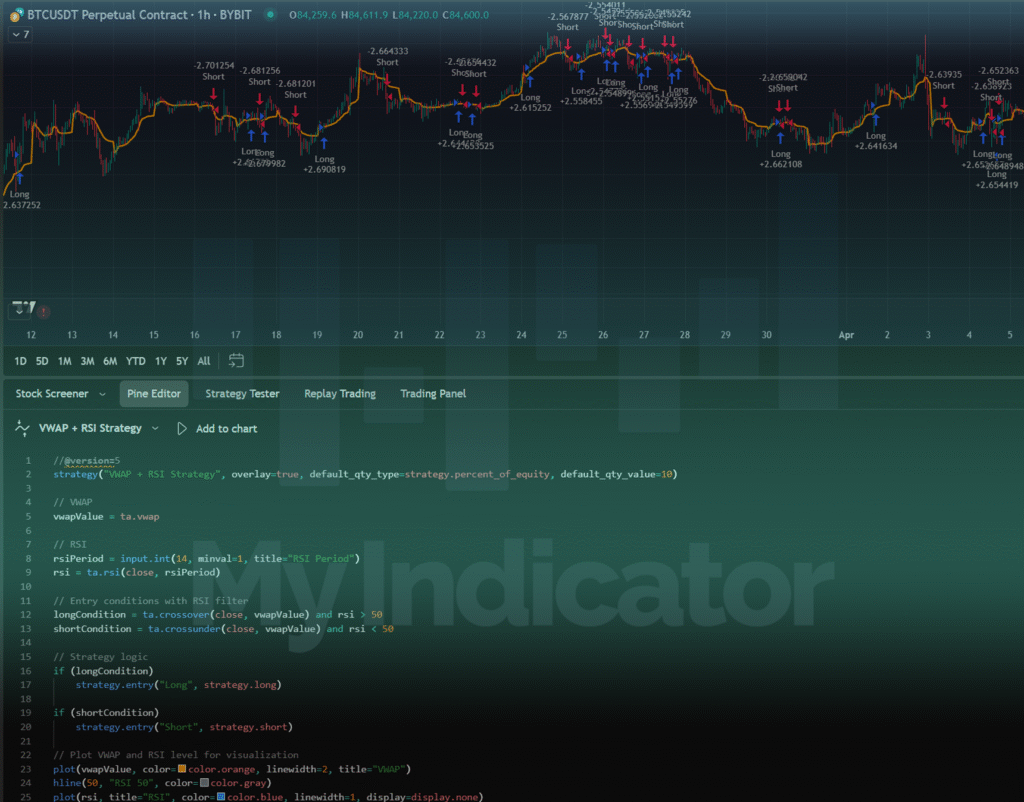
Automation in Trading – From Concept to Strategy Execution
In the fast-paced world of financial markets, automation has emerged as one of the most impactful revolutions in modern trading. What was once the domain of institutional desks and high-frequency hedge funds is now accessible to everyday traders through platforms like TradingView. Automation in trading refers to the use of computer algorithms and systems to execute predefined actions in the market—without the need for manual intervention. This can range from placing simple alerts to running entire trading systems that buy and sell assets based on real-time data.
The core idea behind automation is consistency. Emotions are removed from the decision-making process, and strategies can be executed exactly as designed, every time. Traders no longer need to monitor markets 24/7 or second-guess their instincts. Instead, they rely on code, data, and well-tested logic to do the heavy lifting. This shift opens the door to scalability and efficiency on a level that manual trading simply cannot match.
What Does Automated Trading Involve?
Automated trading involves the creation of rules-based systems. These systems are programmed to respond to specific market conditions: for example, entering a position when a moving average crossover occurs or exiting a trade when RSI reaches a particular level. These conditions can be as simple or as complex as needed, incorporating time, volume, volatility, news feeds, and more.
There are several degrees of automation. At the most basic level, traders can automate alerts—receiving notifications when predefined conditions occur. More advanced users deploy automated scripts that execute trades via broker APIs, or integrate with trading bots that perform entire strategies from entry to exit. Full automation even allows for portfolio-level management and risk control without any human intervention.
Regardless of the complexity, automation is fundamentally about enforcing discipline. It ensures strategies are executed as intended and removes the pitfalls of overtrading, hesitation, and emotion-driven errors. For traders who approach the markets systematically, automation is not just a convenience—it’s a necessity.
Who Uses Trading Automation?
Automation is used across the spectrum of market participants:
Retail traders use automation to manage multiple positions, reduce workload, and avoid emotional decisions.
Day traders implement bots to react faster than manual input allows.
Swing traders automate alerts and strategy triggers for better timing.
Algorithmic traders deploy high-frequency systems based on quantitative models.
Investors use automation for rebalancing, hedging, or dollar-cost averaging.
Even traditional investors benefit from automation by applying rules for re-entry, profit-taking, and risk limits. The growing accessibility of automation tools has democratized these advantages, enabling individuals to operate with the same precision as large institutions.
Benefits of Trading Automation
The appeal of automation lies in its many tangible benefits:
Speed: Automated systems react faster than any human could.
Consistency: The same strategy is applied identically in all conditions.
Emotion control: Decisions are based on logic, not fear or greed.
Backtesting capability: Strategies can be validated on historical data.
Multitasking: Automation allows simultaneous trading on multiple assets or timeframes.
Efficiency: Once configured, systems require minimal oversight.
These benefits culminate in a more streamlined trading process. Automation empowers traders to focus on developing better strategies rather than being glued to screens, reacting to every market movement.
Automation on TradingView – Features and Flexibility
TradingView has become a leader in making automation accessible. Through its integrated scripting engine (Pine Script), users can build automated strategies that function in real-time and historical modes. While TradingView does not execute trades directly, it provides the foundation for rule-based trading by enabling:
Strategy scripting: Define entry, exit, stop-loss, and take-profit logic.
Backtesting: Test your strategies on historical price data to evaluate effectiveness.
Alert automation: Trigger custom alerts based on any indicator, price pattern, or strategy condition.
Integration: Connect with brokers through TradingView-supported APIs or third-party automation platforms.
TradingView’s strength lies in the visual feedback it offers. Strategies can be charted, modified, and debugged live. For traders, this drastically reduces the complexity of working with code and allows for rapid iteration. The platform also supports invite-only and protected scripts, enabling developers to share or sell automated systems without compromising intellectual property.
Building Automated Strategies with Pine Script
At the heart of TradingView automation is Pine Script. Users can write code that tells the system exactly when to enter and exit trades, including conditions for trailing stops, scaling into positions, or dynamically adjusting risk.
For example, a basic strategy might involve buying when a short-term moving average crosses above a long-term one and selling when the reverse occurs. With Pine Script, this can be coded, tested, and visualized in a matter of minutes.
More advanced users integrate machine learning-style logic, multi-timeframe confirmation, or volatility filters. Pine also supports strategy-specific functions such as:
strategy.entry()– define buy or sell signalsstrategy.exit()– define exit rulesstrategy.close()– terminate open positions under specific logicPosition sizing, commission simulation, and slippage modeling
This level of control allows traders to fully simulate the life cycle of a strategy before it’s ever deployed live.
How to Automate a Strategy Workflow on TradingView
Design your idea: Translate your trading logic into clear conditions.
Write or adapt code: Use Pine Script to build the system.
Backtest: Validate the logic on historical data.
Optimize: Tune parameters for consistency and robustness.
Set alerts: Automate notifications to act on signals.
Integrate: Connect to a broker or automation platform if execution is desired.
Even if you don’t code, TradingView offers access to a wide library of public and premium strategies built by professionals. Many are plug-and-play, with customizable settings and built-in risk management.
Final Thoughts
Automation in trading is not about removing the human—it’s about enhancing the human. It brings together the best of logic, consistency, and technology to remove guesswork and empower better decision-making. Whether you’re an experienced trader or just getting started, integrating automation into your trading approach can radically improve your edge and efficiency.
TradingView makes this not only possible but practical. With its scripting tools, alert systems, and visual interface, you have everything needed to turn your trading plan into a fully automated strategy.